Free shipping, no minimum · 90-day guarantee · Made in Orange, California
The Sectional Cup Holder.com ← back to the sectional page

The sectional guides

Every seat on a sectional, mapped: where a drink can actually go

The chaise, the armless middle, the corner, the console: what every seat on a sectional actually has to set a drink on, and what fits where.

12 min read · 14 sources

Every seat on a sectional, mapped: where a drink can actually go

You bought a couch that seats six. It came with two arms.

That is the trade nobody spells out in the configuration builder. A standard sofa is three seats arranged around one coffee table. A large sectional — Coleman Furniture puts the big ones at 120 to 156 inches and up — is six or seven seats arranged around the same one coffee table. The seat count roughly doubled. The number of hard, level, load-bearing surfaces attached to the furniture did not move at all.

So "where does the drink go" doesn't have one answer on a sectional. It has a different answer at every seat, and at two or three of those seats the honest answer is nowhere, and no table you can buy will change it.

Here is the map: what each module class actually has next to it, what works there, and what fails and why. If you want the physics of why a full glass goes over on a cushion in the first place, that has its own page. This one is geography.

The rule underneath the map: hard edges don't scale

Three things on a sectional are hard, level and structural enough to hold a drink without help: an arm, a console lid, and a table you park beside it. Everything else is foam.

Arms come two per sectional, however long it gets. And modular systems are built to delete them. An armless module adds a seat and zero edges. A corner seat adds a seat and zero edges. Home Reserve's standard wide pit sectional is a wide left end seat, a wide right end seat, two wide armless seats, two corner seats and two corner ottomans — eight modules, two arms, and the two arms are as far apart as the furniture can physically put them.

The pit is the extreme case, and it's also the silhouette everyone is buying. Povison describes a pit sectional as corner seats, armless modules and centre pieces filling "most or all of a U-shaped opening" — which is also an accurate description of a couch that has closed off the floor the coffee table used to stand on. Their own advice, once the centre is filled, is that giving up the traditional coffee table may be worth it — and that what replaces it is low side tables at the outer corners and trays for the inner seats.

Everything below follows from that one rule. A seat's options come from what it is physically next to. Not from what's in the room.

Seat 1 — the end seat with an arm

This is the only seat on the couch that was ever actually solved, and only if the arm is the right shape.

A track arm or a square arm has a real plane on top. IKEA's RÖDEBY armrest tray fits flat armrests from 4 to 12 inches wide, which comfortably covers what modular systems ship — a Lovesac Sactionals Standard Side is 6 inches through, dead centre of that range.

Here's the part that costs people twenty dollars: the spec everyone checks is width, and the spec that actually decides it is flatness. Lovesac's rolled armrest is the same 6 inches thick as the standard one. It just curves. A tray rated for flat armrests 4 to 12 inches wide does not care that your rolled arm measures 6 inches, because none of those 6 inches are level. That mismatch — right width, wrong geometry — is the single most common reason the tray bought for this couch is now behind the closet door.

Worth knowing even when the arm does work: it is nowhere near your hand. Designing Idea's breakdown of the Sactionals dimensions puts 10.5 inches of vertical space between the seat surface and the top of a standard armrest, and Burrow's Nomad pairs a 17-inch seat height with a 25-inch arm. A glass up there is eight to ten inches above the cushion you're lying on, on the outermost edge of the furniture, in the walking lane.

Verdict. Flat arm: buy the tray, it's the best surface on the couch. Rolled arm: the arm is decoration. Treat this seat like the armless ones below.

Seat 2 — the chaise

The chaise has the deepest seat and, usually, nothing beside it. On most modular configurations the chaise is armless on the inboard side by definition, and where it does carry an arm, that arm is outboard — past your shoulder, behind the line of your body once you've actually stretched out. Nobody sits upright on a chaise. That's what it's for.

But the chaise has one asset no other module has: floor.

A chaise projects. Coleman lists chaise extensions at 60 to 72 inches and up; Burrow's Nomad chaise runs 61 inches deep against a 36-inch sofa depth. That overhang leaves a pocket of floor along the outboard side of the chaise that is not a walkway, because the chaise itself already blocks it. In most rooms that pocket is the only place a small table can stand without being in somebody's path.

If you're filling it, pick the height off the arm, not off the coffee table. Eureka Ergonomic flags an arm-height mismatch of more than 1.5 inches as the point where the table sits awkwardly high. They write that rule for C-tables and the clearance under a sofa arm, but the principle travels to anything you park alongside. C-tables generally run 20 to 26 inches tall and side tables 22 to 28, so measure floor-to-arm-top first and shop to that number.

One precondition: a C-table needs somewhere for its foot to go. Its whole design premise is that the base slides under the furniture. On a plinth base, a platform base or a skirted sectional there is no under, and the C shape gives you nothing a plain side table wouldn't.

Verdict. Chaise with an outboard floor pocket: side table, height matched to the arm. Chaise against a wall or a walkway: no hardware answer — see the last section.

Seat 3 — the middle of a long run

This is the worst seat in the house, and the arithmetic is brutal.

A Lovesac Sactionals Seat is 35 inches square. Sit centred on an armless seat with another armless seat on either side, and the nearest arm's inner face is 17.5 inches (to the edge of your own module) plus 35 inches (across your neighbour's) — 52.5 inches away. In both directions. Eureka's own reach chart has no category that far out — it puts an end table 15 to 20 inches away and already calls that the secondary reach zone. Fifty-two inches is not a reach in either direction, and the coffee table is out in front past a seat depth that on a deep sectional can run 39 or even 47 inches.

There is no table that fixes this. No arm to clamp to. No floor to stand on — there's couch on both sides. Nothing in front but the reach you already can't make.

With one exception, and it's the best-kept move on this whole list.

The back of the run

If your sectional floats — if it isn't shoved against a wall — the back of a straight run is the only place on a sectional where one surface serves several seats at once.

A console or sofa table behind the couch should sit at or just below the height of the sofa back, typically 28 to 32 inches, 10 to 15 inches deep, and 50 to 75 percent of the sofa's length, with 6 to 12 inches of gap behind the sofa and 30 to 36 inches kept clear as a walkway. A 60-inch console behind a three-module run puts a hard, level edge within a shoulder-turn of three seats simultaneously. Nothing else on this page does that.

The preconditions are strict, so check them honestly. The sectional has to float. The back run has to be straight — a chaise or a corner that turns the back breaks the run into two short unusable stretches. And you need the walkway; Povison uses the U.S. Access Board's 36-inch minimum clear width as a sanity benchmark for circulation around a pit, and if a console eats that, it goes.

There's also a real limitation nobody mentions: it puts the drink behind your shoulder. Fine for a water bottle you sip between scenes. Not fine for a full glass in a dark room with a dog moving around.

Seat 4 — the corner

The corner is landlocked, and everyone wants it.

It has no arm — a corner module doesn't have one, that's what makes it a corner. It has foam on two sides. Outside it is either a wall or the walkway you just agreed to keep clear. And you don't sit square in a corner, you sit into the diagonal, which is the longest line on the module. 7th Avenue's corner seat measures 47 by 39 inches, and their extra-deep option takes the depth to 47 as well.

So the seat that swallows you deepest is also the one seat on the sectional where no table of any kind can physically reach. This is where the hardware map runs out.

Seat 5 — the console

The console isn't a seat. It's a divider between two of them, and it's worth being precise about what that means for where drinks land.

Ashley's Top Tier six-piece is a representative build: a press-back chaise, an armless recliner, an armless chair, a console with storage, a wedge and a recliner — with a centre console carrying two cup holders and hidden storage. One console. Two wells. Serving whoever happens to be flanking it, and only for containers the well accepts. (What a console well will and won't take is covered on the main page.)

The actionable part happens earlier than you'd think — at the order screen. If your configuration lets you choose where the console module goes, put it between the two seats that get used on a normal Tuesday, not in the middle of the long run where the showroom renderings always place it for symmetry. The renderings are optimising for the photo. You're optimising for the two people who are actually on the couch at 9pm.

And don't overlook the lid. On a fixed-top console it's a genuine hard, level surface at roughly arm height, reachable from both flanking seats — the second-best surface on the couch after a flat arm. On a flip-top storage console it's much less useful, because opening it evicts everything standing on it, which is exactly the moment someone wants the remote that's inside.

Seat 6 — the ottoman and the pit centre

The ottoman is the surface everyone defaults to, and its problem is a height problem that's actually correct by design.

Designers set a coffee table or ottoman level with the seat cushion or 1 to 2 inches below it — with sofa seats typically 17 to 20 inches, that puts tables at 16 to 18. That's right for comfort and reaching down. It also means everything on the ottoman is at knee-and-shin height, in the middle of the only route across the room, in the dark, with people crossing it.

On a closed pit it's worse, because the ottoman is a seat. The shared surface, the traffic lane, somebody's footrest and somebody else's seat are all the same object. That's why the ottoman ends up holding four cups and none of them belong to anyone sitting near it.

The five-minute audit

One tape measure, one pass around the couch. Do this before you buy anything.

The seats the map can't solve

Run that audit honestly and most households end up having solved one or two seats and staring at three: the corner, the middle of a run, and a chaise with no floor beside it. Those three have no hardware answer, and not because nobody's built the right table. Because there's nowhere to stand it. What's next to those seats is a cushion, and it always will be.

Which is the argument for building the stability into what the drink stands in, because at those three seats there is nothing beside you to stand it on.

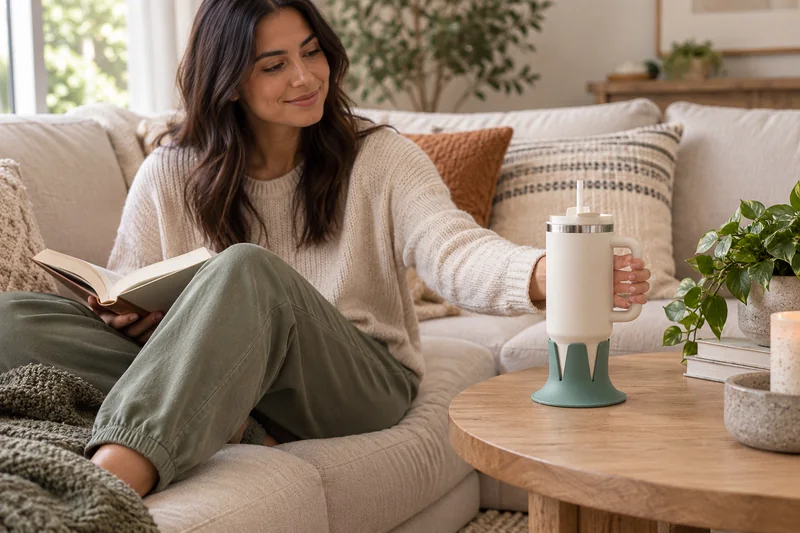
That's what the Steadi is. One piece of Shore 85A TPU — a flexible engineering plastic, not silicone — 2.8 inches tall, with a base 5.2 inches across. That number is fixed: the base doesn't expand, contract or deform under the container. The fins above it flex to grip the bottom inch of whatever's standing in it.

The mechanism is plain geometry. A tumbler standing on its own has a narrow footprint. Standing in the Steadi, the base of support underneath it is 5.2 inches across, so the container's centre of mass has to travel considerably further sideways before it passes outside that footprint — which means it takes a much larger tilt to tip. That larger tilt is the margin you want when someone drops onto the cushion beside you and the foam re-shapes. The TPU's tack does the other half of the job, resisting the slide across a cushion, an ottoman top or a console lid.

Where it honestly doesn't apply, so you don't find out the hard way: it is not a mount, a clamp, a strap or a restraint, so a direct hard knock still wins — a kicked drink is a kicked drink. Handled mugs are a straight no; the handle sits exactly where a fin needs to be. It doesn't insulate and it doesn't seal. It goes in the dishwasher. It's molded in Orange, California, and it's patent pending.

And where the hardware does exist, use the hardware. A flat track arm deserves a tray. A chaise with a floor pocket deserves a table. This isn't the answer at every seat — it's the answer at the seats a table can't reach, which on a big modular sectional is usually the seats people actually fight over.

How many surfaces do you actually need

Count seats that get used, not seats on the invoice.

A seven-module sectional runs two or three occupied on a normal night, and five or six twice a month. The map above tells you which of those are already covered by an arm, a console lid or a table with floor to stand on. Solve the remainder. Nobody needs a surface per cushion; you need one at the chaise, one at the corner, and one wherever the third person lands.

That's the whole exercise. The couch multiplied the seats and left the surfaces alone. All you're doing is finishing the job it started.

Guarantee: 90 days from delivery, free returns, used is fine. Checkout runs through the maker's own store at steadilabs.com.

Wondering about your specific cup? The fit database has sourced base measurements for 30+ containers — Stanley, Red Bull, Yeti, and the honest no's.

Sources

  1. Coleman Furniture — Large sectionals run 120-156 inches and up; chaise extensions run 60-72 inches and up; seat heights 17-20 inches.
  2. Home Reserve — A standard wide pit sectional is built from a wide left end seat, a wide right end seat, two wide armless seats, two corner seats and two corner ottomans - eight modules, two arms.
  3. Povison — A pit sectional uses coordinated corner seats, armless modules and ottomans or centre pieces to fill most or all of a U-shaped opening; with the centre filled, the page says giving up a traditional co
  4. IKEA — The IKEA ROEDEBY armrest tray fits flat sofa armrest widths from 4 to 12 inches and is designed for flat armrests, not rounded ones.
  5. Lovesac — The Lovesac Sactionals Standard Side measures 35 inches wide, 28.5 inches tall and 6 inches deep.
  6. Designing Idea — A Sactionals Seat base is 35 by 35 inches with an 18-inch seat height and 10.5 inches of vertical space between the seat surface and the top of the standard armrest; the rolled armrest is the same 6 i
  7. Dimensions.com — The Burrow Nomad chaise sectional has a 17-inch seat height, a 25-inch arm height, 36-inch sofa depth and 61-inch chaise depth.
  8. 7th Avenue — 7th Avenue's corner left seat measures 47 inches long by 39 inches deep; the range is offered in 39-inch Classic and 47-inch Extra-Deep seating depths.
  9. 7th Avenue — 7th Avenue sectionals are listed at 39-inch and 47-inch depths across configurations.
  10. Eureka Ergonomic — An arm-height mismatch of more than 1.5 inches between a sofa arm and a C-table causes the table to sit awkwardly high; the page's reach-zone table places an end table at 15-20 inches as the secondary
  11. Furnirem — C tables run 20-26 inches tall, side tables 22-28 inches, and sofa tables 28-32 inches tall by 10-15 inches deep; a C table's premise is that its base slides directly under the sofa.
  12. Homebaa — A console table behind a sofa should sit at or slightly below the sofa back, typically 28-32 inches tall, 10-15 inches deep, 50-75 percent of the sofa's length, with 6-12 inches of gap behind the sofa
  13. Hernest — A coffee table should be level with the sofa seat or 1-2 inches lower; most sofa seat heights range 17-20 inches, putting coffee tables at 16-18 inches.
  14. American Furniture of Slidell (Signature Design by Ashley) — Ashley's Top Tier six-piece sectional comprises a press-back chaise, an armless recliner, an armless chair, a console with storage, a wedge and a recliner, with a centre console carrying two cup holde
Choose your colors — free shipping

You'll finish at steadilabs.com — Steadi Labs is the manufacturer.